
Pride Compass Journal
Queer Life Beyond the Capital Cities: Finding Community in Regional Australia
A festival in a country town, a familiar face at a monthly gathering, somewhere you can be yourself. Queer Australia has plenty happening beyond the capital cities.
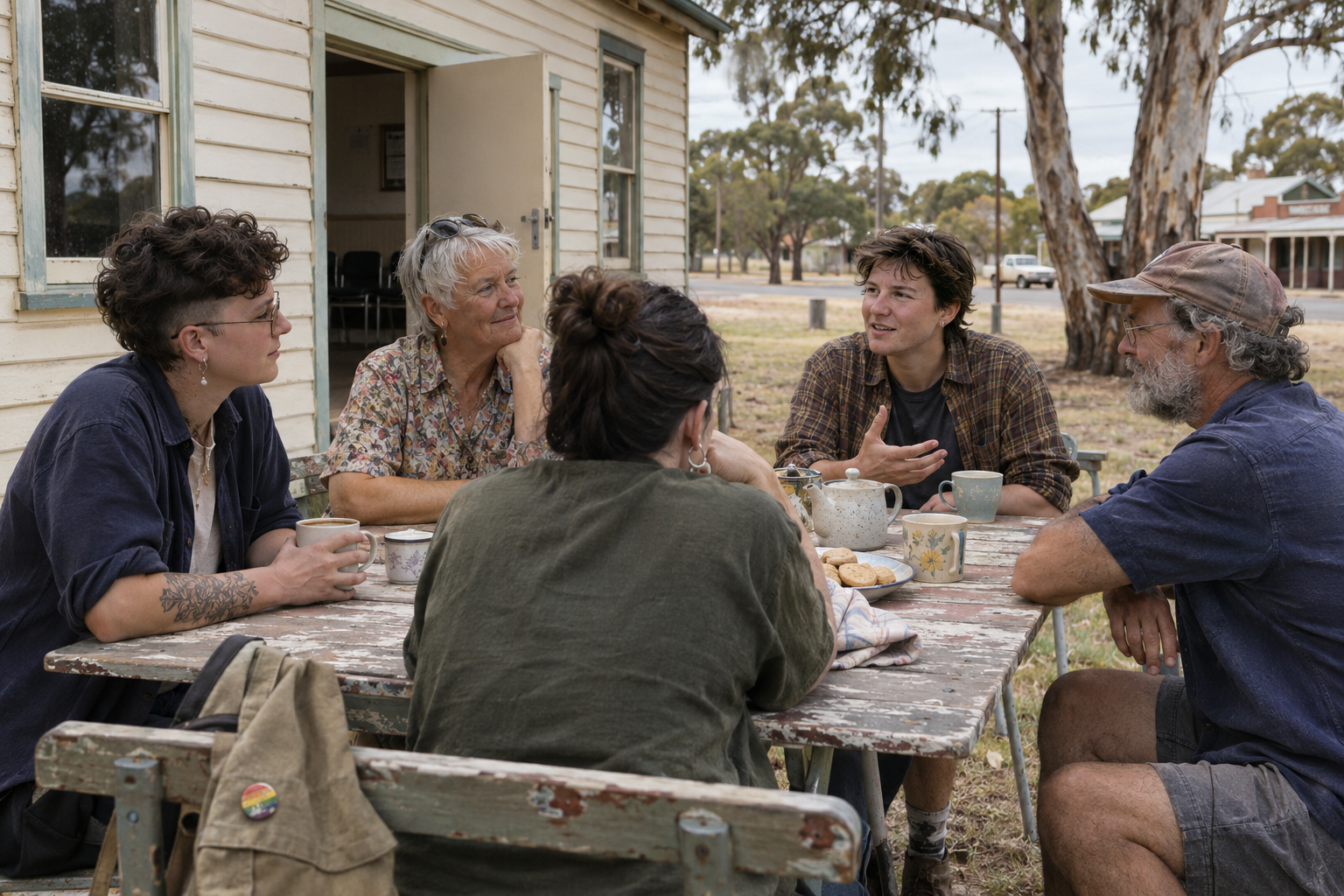
When we talk about LGBTQ+ Australia, the conversation has a habit of finding its way back to Sydney Mardi Gras, Melbourne’s bars and the big city festivals. Fair enough. There is plenty to talk about.
But there is an awful lot of Australia beyond those places. And an awful lot of LGBTQ+ people getting on with their lives in it.
Some grew up in regional towns and stayed. Others left, then returned. Some moved for a partner, work, family or the possibility of a garden that doesn’t have to live entirely in pots. Their lives deserve a little more attention than the occasional story about somebody escaping to the city.
You shouldn’t have to leave to belong
The appeal of a capital city is easy to understand: more places to meet, more anonymity, more chances to find people who understand you. For someone who has felt watched or isolated, that can mean an enormous amount.
Yet moving is a personal decision, with practical limits. Leaving a job, family or Country is no small thing. Nor should wanting a queer social life require wanting a completely different life.
Regional belonging might mean finding a regular gathering rather than a whole street of venues. It might involve knowing who organises the local Pride event, or discovering a group you can join without explaining yourself before the conversation gets started.
That is a worthwhile life to build where you are.
Just look how far we’ve come
It helps to pause occasionally and remember what earlier generations were up against.
South Australia introduced a limited legal defence in 1972, then fully decriminalised consensual sexual activity between men in 1975. Other jurisdictions followed over the next two decades. These reforms primarily concerned sexual conduct between men; saying that being LGBTQ+ was itself a single criminal offence obscures that history. Lesbian experiences of exclusion and discrimination had a different legal context. The Museum of Australian Democracy explains the early reforms.
The broad sequence was:
| Jurisdiction | Main decriminalisation reform |
|---|---|
| South Australia | 1975, following limited reform in 1972 |
| Australian Capital Territory | 1976 |
| Victoria | Legislation in 1980; effective in 1981 |
| Northern Territory | Legislation in 1983; effective in 1984 |
| New South Wales | 1984 |
| Western Australia | Legislation in 1989; effective in March 1990 |
| Queensland | Legislation in 1990; effective in January 1991 |
| Tasmania | 1997 |
The distinction between passing a law and bringing it into force explains some apparently conflicting dates. The Australian Queer Archives’ legal history records those stages separately. Decriminalisation also did not immediately remove every unequal age-of-consent rule or discriminatory provision.
Tasmania’s repeal came in 1997. That is within the adult memory of many people reading this, not some distant chapter safely separated from the present.
Change took campaigners, community organisations and people willing to risk considerable personal consequences. In Tasmania, that included the work of Nicholas Toonen, Rodney Croome and the Tasmanian Gay and Lesbian Rights Group. The Australian Human Rights Commission recounts the struggle and federal intervention.
Progress was fought for. Remembering that makes today’s opportunities feel rather less ordinary.
The difficult bits haven’t disappeared
Of course, legal change and feeling comfortable at the local shops are different things.
On 30 June 2026, Charles Sturt University reported findings from the Regional Rainbow Survey. Its news report described 117 rural and regional LGBTQ+ adults: more than 40 per cent reported discrimination from strangers, approximately a quarter from work and from family and friends, and 15 per cent while accessing physical healthcare. Participants also perceived increasing hostility, particularly towards trans people.
There is an important qualification. The linked 2025 survey report identifies its 117 rural and regional respondents as living in NSW. Recruitment was online through community networks and advertising. This small, self-selected sample cannot stand for every regional Australian. Reports of increased hostility are participants’ perceptions, not proof of a nationally measured rise.
The experiences still deserve attention. Finding an affirming GP, managing travel and deciding how visible to be can complicate daily life. Privacy may feel particularly precious when social circles overlap. A friendly festival weekend cannot, by itself, solve access to healthcare or the worry of being treated differently at work.
Equally, those difficulties should not become an excuse to describe every country town as hostile. Places differ. So do the people living in them.
People are making things happen
Look at what communities are organising, and the picture becomes considerably broader.
In Daylesford, Victoria, ChillOut brings queer country life into the foreground. Its March 2026 festival is now past; the organisers are advertising the next festival for 27 February to 8 March 2027. Behind it is a charity run by a committee of locals. A regional town is the destination, with its own community doing the organising.
In Gladstone, Queensland, volunteer-led Rainbow on the Reef marked its fifth Pride festival in May 2026. The programme included a free family-friendly Fair Day, a film night and a marina brunch. Organisers also advertised a free bus from Mackay. Transport belongs in the community-building conversation just as much as entertainment does.
Over in Western Australia’s Great Southern, Albany Pride’s current calendar offers something especially useful: reasons to meet again. November’s programme includes TransVerse for trans, nonbinary and gender-diverse people, social support gatherings and a group for younger people, alongside end-of-month drinks. You don’t have to make the drinks your first visit if something quieter would suit you better.
Tasmania offers another reminder that connection needn’t wait for a festival. Working It Out provides sexuality, gender and intersex support, education and advocacy. Its November calendar includes a youth gathering in Devonport and queer drinks in Launceston. Both are beyond Hobart, and both make the next step a little more concrete than “try meeting people”.
Sport has a place here too. Pride Cup lists a Gippsland Ranges Roller Derby event in Warragul for 7 November 2026. Someone looking for community might be more interested in joining a team than booking a cabaret ticket. It is good to have the choice.
Or put your walking shoes on. In the Blue Mountains, Bush Lemons brings people together through bushwalking and outdoor activities. The group’s own website is advertising its 30-year anniversary celebration for November 2026. There is a fair bit of shared history behind a group that has been getting people out into the bush for that long.
In the Northern Territory, fabALICE puts drag, cabaret and local talent into an Alice Springs setting. Its organisers are also promoting the next festival with 2027 early-bird bookings. The Red Centre gets to tell its own queer story, with a personality that belongs to the place.
Workplaces matter as well. Pride in Diversity’s Regional Reach programme includes Mount Gambier, South Australia, in its 2026–27 plans, and advertised a Queanbeyan event in September 2026. These are practical opportunities for local employers and communities to work on inclusion between the celebrations.
None of these examples proves that every regional town has everything it needs. They do show people building opportunities locally, in quite different ways.
A social life with room for different people
Queer bars and clubs still matter. They can offer freedom, pleasure and the lovely relief of being somewhere you don’t feel like the exception. A regional festival can provide that feeling on a scale an ordinary weekend cannot.
But nobody should have to enjoy late nights to qualify for a community. Some people want a walking group, a team, an arts project or a table where they can hear the conversation. Others would like all of those things, depending on the week and the condition of their knees.
Regular gatherings offer the possibility of becoming familiar. You recognise somebody from last time. There is less to explain. Eventually, arriving alone may stop feeling quite so much like arriving alone.
For someone considering a first visit, a short message to the organiser can help: are newcomers welcome, what does it cost, and what access is available? If privacy matters, ask about photographs. Being part of a community should leave room for deciding how publicly you participate.
Finding your people, wherever you live
What has surprised me while researching regional listings for Pride Compass is the variety. There are festivals, certainly, but also bushwalking groups with decades behind them and regular gatherings that rarely make a national headline. I want the directory to help people find those things, particularly when they don’t already know a local who can point them in the right direction.
Alongside Bush Lemons, you can find profiles for Tandy’s Alehouse in Launceston and Ritual Kangaroo Island in Kingscote, or browse the wider directory. Check with the business or organiser for current details before making plans. If you know a regional group or welcoming place we should investigate, send us a suggestion.
Australia still has work to do. The distance between legal equality and everyday ease can be considerable, and nobody owes anyone a cheerful account of an experience that has been difficult.
In 1997, Tasmanian campaigners were still fighting to remove laws criminalising consensual sex between men. Today, a teenager in Devonport can find an advertised queer youth gathering, while people across the country organise Pride weekends in their own towns. Those changes took people who refused to accept things as they were.
That is an extraordinary distance to travel within living memory. And every local group that keeps meeting, every organiser who puts another date in the calendar, gives someone else a chance to belong without leaving home.