
Pride Compass Journal
Where We Spend Matters: Keeping Our LGBTQ+ Spaces Alive
Coming back to Sydney has made me think about the places we remember, the ones still here, and the new ones worth finding. Sometimes supporting them starts with deciding where to have coffee.
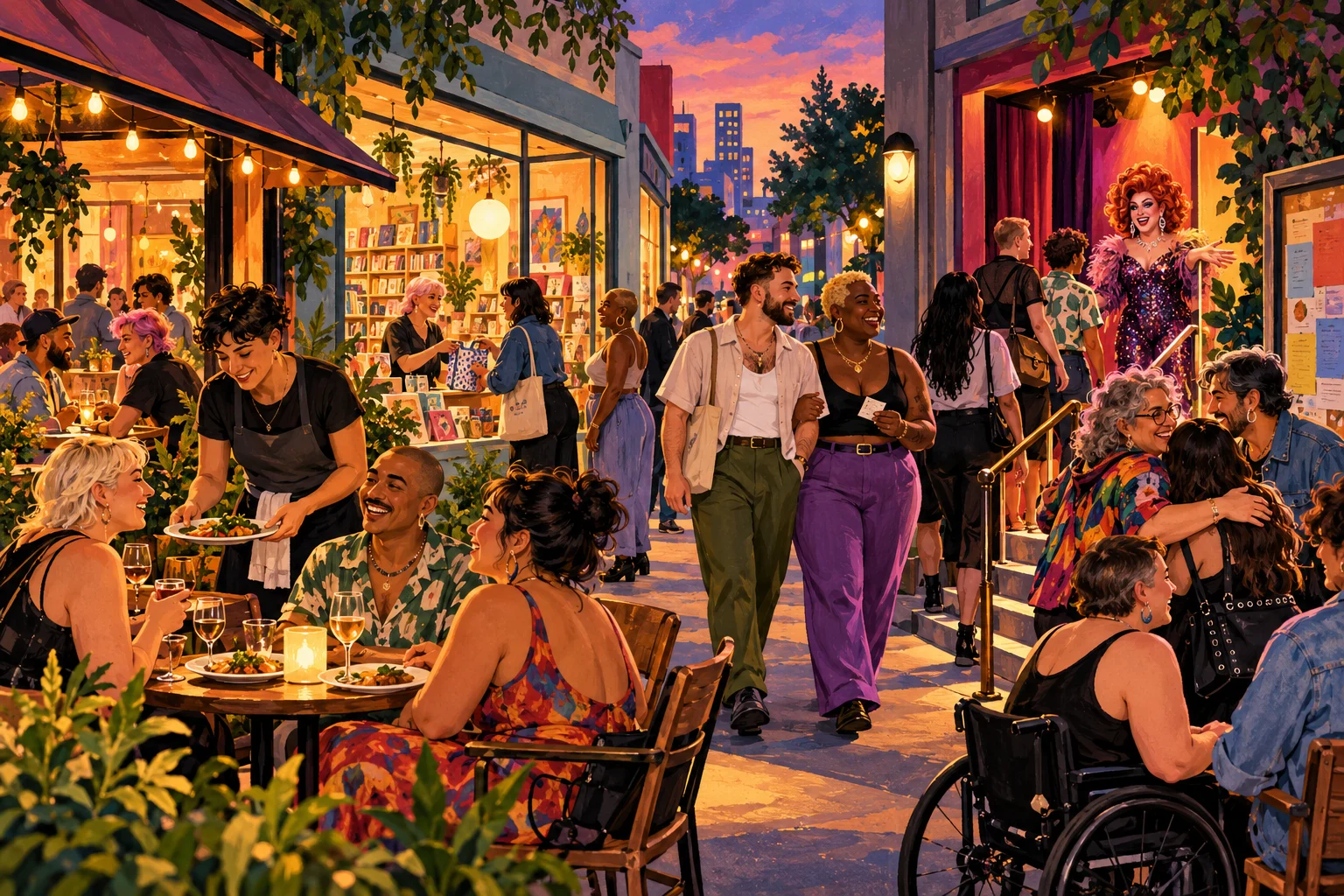
Coming back to Sydney after living here many years ago has been a strange mixture of recognition and discovery. Walking around Oxford Street, some names are familiar. Others have gone. Researching the streets for Pride Compass has made me pay closer attention to both.
I remember a time when LGBTQ+ venues, businesses and publications had a particularly visible place in community life. Returning now, I find myself thinking about what those places meant, but also about something less nostalgic: whether we actually use the places we want to keep.
It is easy to feel fondly about a venue without having been through its door for years. I can understand that. Lives change, tastes change, and a late night out might have much less appeal than it once did.
Still, what happens when we stop using the spaces we say are important to us?
Eventually, some of them disappear.
That thought is part of why I am building Pride Compass Australia. When we are already going out for dinner, buying a present or choosing a show, I would like it to be easier to find somewhere with a real connection to our community. Then we can decide whether to spend there.
The pink dollar, with a different purpose
Living in the UK, I remember the idea of the “pink pound”: the recognition that LGBTQ+ consumers had collective economic influence. Australia had its own pink dollar, with business and community interests visibly intertwined by the late 1980s and 1990s.
Melbourne offers a useful example. Midsumma’s published history describes how the Gay Business Association helped bring the festival into existence in 1988. Encouraging spending in local shops, restaurants and venues sat alongside pride in Melbourne’s community. The same history, drawing on LGBTQ+ publications, records the arrival of substantial commercial sponsorship in the mid-1990s as companies pursued the pink dollar.
Sydney had its own tensions around that attention. In a National Museum of Australia discussion, former Mardi Gras president Robyn Laverack recalled corporate enthusiasm for that market, including approaches from businesses whose values did not align with the organisation’s.
Some of the old sales pitch leaned on a narrow picture of affluent gay consumers. I have no interest in reviving that picture. There is no single LGBTQ+ household budget, and belonging to this community tells you very little about what someone can afford.
What interests me in 2026 is where the money we are already spending goes. A company asking how to get our custom is one thing. Us asking which businesses help make our lives better is a rather more useful starting point.
Affection does not pay the rent
In March, the ABC reported Stonewall Hotel’s departure from Oxford Street after 28 years. Its reporting placed that loss in the context of redevelopment, rising rents and the long aftermath of Sydney’s lockout laws.
There is an important continuation to that story: Stonewall’s own history now follows it into Newtown. Losing a familiar Oxford Street address and having somewhere new to gather can both be true. That seems a better way to understand change than assuming every departure means community life has ended.
A business still has to cover rent, wages, insurance and utilities. Its history cannot settle those bills. Cost-of-living pressures can squeeze what customers have left for a night out, while changing habits, different foot traffic and competition from other venues affect where that money goes.
None of this makes customers responsible for every closure. Management decisions, leases and redevelopment can put a business in difficulty regardless of how much people care about it. Nor should anyone stretch a tight budget to keep somebody else’s business afloat.
But where there is a reasonable choice, our custom is one part of the picture we can influence. A regular dinner booking is something a restaurant can build on. An occasional visit is more useful to a café than being remembered affectionately from a distance.
There is a whole community beyond the bar
I care about nightlife, but I would hate for this conversation to stop there. Some people do not drink. Some do not enjoy clubs. Their connection to LGBTQ+ life should not depend on either.
There are restaurants where we can relax over dinner, cafés where meeting a friend becomes a weekly habit, and independent retailers worth looking for before making another automatic online purchase. Accommodation and professional services matter too. Finding a place to stay, an accountant or another provider who treats you and your partner comfortably can make an ordinary transaction easier.
Community organisations belong in this picture, although their funding and purpose differ from a commercial business. Attending a fundraiser or a community event can help sustain a place whose value reaches well beyond its paying customers.
Then there are the arts. I particularly want Pride Compass to help people find arts and cultural spaces: galleries, theatres, live performance venues and independent cinemas, as well as LGBTQ+ artists whose work appears in all sorts of settings.
A queer film screening needs an audience. A cabaret night needs people in the room. Buying a ticket to a drag show helps make the performance possible, including the work we never see before the performer walks onstage. A gallery event can introduce us to an artist we might later buy from, commission or recommend.
It is lovely to see a programme and think how good it is that someone has organised it. Sometimes the useful next step is to message a friend and book.
There is plenty happening beyond Sydney. Brisbane’s Melt has announced a 2026 programme across more than 70 venues. Feast in Adelaide and regional South Australia puts queer arts and culture at its centre. In Western Australia, Pride WA’s purpose explicitly includes community, culture and the arts. Regional gatherings matter too: Bendigo Pride’s 2026 programme included an after-party at Bendigo Trades Hall.
These are different communities making things happen in different ways. They are reasons to look around with curiosity, rather than imagine that LGBTQ+ culture belongs to a few famous streets.
Ticket sales are not the whole funding model for every festival or arts organisation. Grants, donations, sponsorship and volunteers can all matter. Even so, an audience gives organisers a reason to programme the next night. Repeatedly empty seats can mean fewer opportunities for performers, and eventually no next event to put in the diary.
If we want room for new LGBTQ+ voices, going to see them is a fairly practical place to start.
Support has to be earned
I would not ask anyone to support a business merely because it calls itself a gay venue. Nor does LGBTQ+ ownership excuse poor service, inflated prices or an unwelcoming experience.
A rainbow in the window cannot tell you whether a trans customer will be treated respectfully. A famous name cannot tell you how the business operates under its current management. Community connection needs to show up in what people do.
That is the thinking behind our first article, A Rainbow Sticker Isn’t Enough. Pride Compass looks for meaningful evidence of ownership, community involvement and inclusion, while recognising that we cannot guarantee any individual’s experience. A business missing from the directory may simply not have been researched yet.
I want people to discover businesses that earn their confidence. Returning because the food was good, the staff were welcoming and you enjoyed being there is a much stronger foundation than returning out of obligation.
Imagine you are choosing somewhere for a drink, between Bar A and Bar B. Both suit your budget and the sort of evening you want. Bar B also has a demonstrable commitment to the LGBTQ+ community. That seems a good reason to give it a try.
The same goes for Restaurant A or Restaurant B, one café or another, the shop you buy a gift from, or the service provider you call. If two shows appeal, perhaps choose the one giving LGBTQ+ performers a stage this time.
There is no requirement to spend exclusively within the community. Price, accessibility, location and quality all belong in the decision. I am suggesting we let community connection count when we have a choice that works for us.
What a booking can help keep going
The potential benefit extends beyond the owner. Depending on the business, revenue can help sustain jobs for LGBTQ+ staff, fees for DJs and performers, orders from suppliers, or a room made available for a community gathering. A viable venue may be better placed to host a fundraiser or sponsor a local event.
Those possibilities are not a promise about every dollar spent. They are reasons to notice how a business participates in the life around it.
There is a social reason to care as well. ILGA-Europe’s 2026 review of bias-motivated speech documents hostility towards LGBTQ+ people, including rhetoric from far-right political figures. Against that background, places where we can gather, make art and feel comfortable being visible take on particular importance.
I cannot control all of that public discourse. I can choose where I show up, and I would rather put some energy into a place that makes being together enjoyable.
Oxford Street does not have to become the street I remember. Community life can grow elsewhere, in new venues and unfamiliar suburbs, alongside institutions that have endured. I want the directory to help us find both. Its coverage is still growing, so it will not yet answer every question in every town.
But the questions themselves are ordinary enough. Where shall we have coffee? Where would be good for a birthday dinner? Which show should we see this weekend? Who can provide the service we need?
No single purchase will save a precinct. Thousands of choices, though, bring people through doors. That foot traffic becomes revenue, and revenue helps keep somewhere open for the next person who needs to find it.
That is what I keep coming back to as I build Pride Compass Australia. If it helps you find somewhere you did not know about, and you decide to walk through the door, it is already doing something I hoped it would.