
Pride Compass Journal
LGBTQ+ Rights in Australia. How Far Have We Really Come?
From criminalisation and the first Mardi Gras to HIV activism and marriage equality, Australians won change through decades of organising and supporting one another.
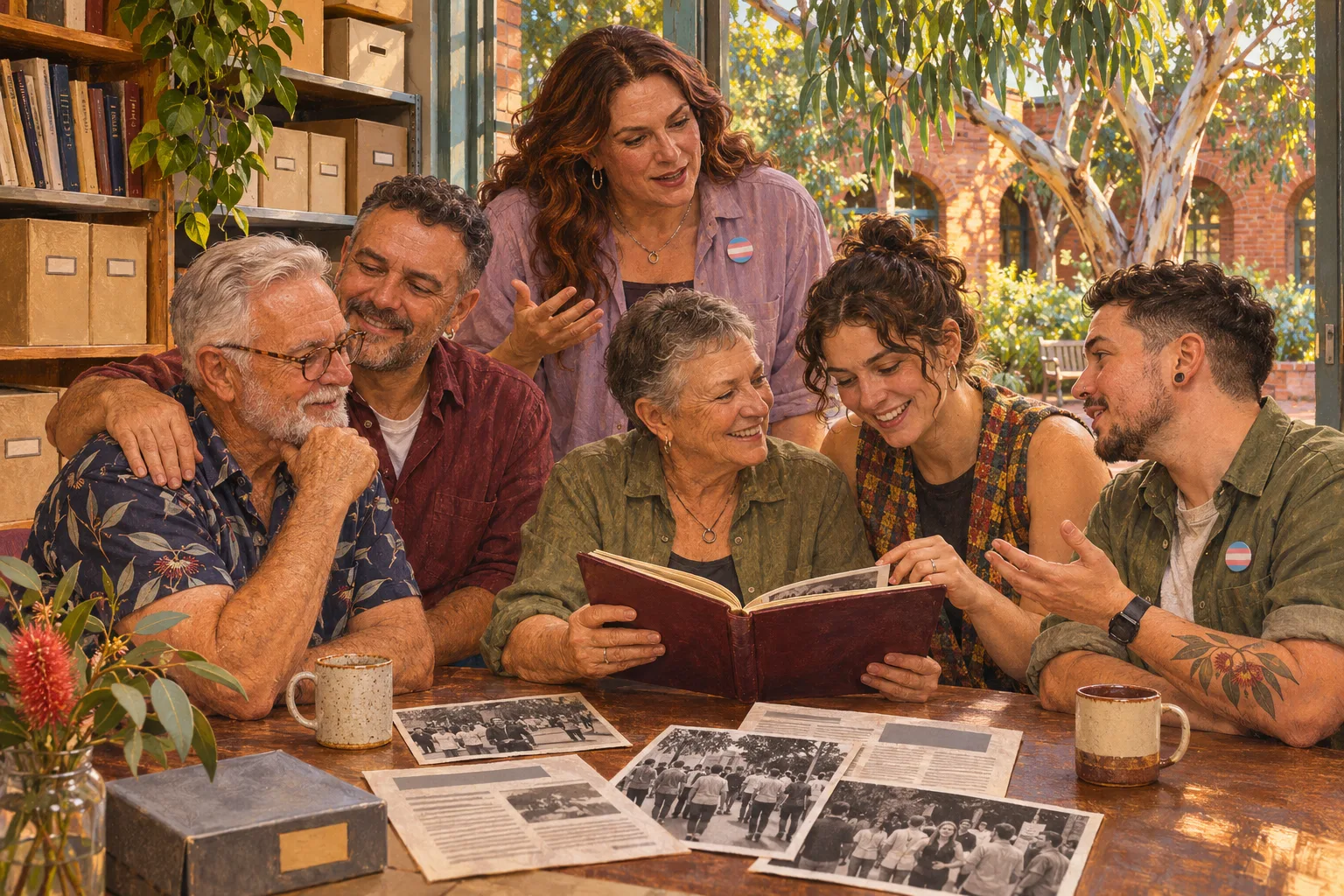
For a gay man in New South Wales in the early 1980s, the possibility of arrest for sex with another man belonged to the present. So did the risk that being outed could cost him his job or give someone the means to blackmail him. Today, he can marry that same man.
Many Pride Compass readers have lived through that change. Others grew up with freedoms their parents’ generation had to campaign and fight for, and may find it difficult to imagine how recently those freedoms were denied. Looking at LGBTQ+ rights in November 2026 means remembering how we got here, including the friendships and alliances that made change possible. Gay men, lesbians and trans people faced different dangers, but often found reasons to organise around our common struggles together. Much of what we now take for granted grew out of people deciding to band-together and help one another.
When being openly gay carried real risks
Laws criminalising consensual sex between men fell particularly heavily on gay and bisexual men. Legally, the offences concerned the sexual acts themselves, rather than the identity of being gay. In practice, that distinction offered little comfort to someone afraid of police attention, exposure or losing his livelihood.
A 1991 Australian Institute of Criminology paper described blackmail, police intimidation and men’s reluctance to report crimes against them. It also documented differences in enforcement between jurisdictions, including the use of police decoys to entrap gay men in Queensland in 1988. If telling the police what had happened also meant revealing your sex life, asking for help when you needed it could feel like taking another risk. Sadly, many gay men suffered voilence against them in silence for fear of recrimination.
Lesbian sexual conduct was generally not criminalised under equivalent Australian laws. That did not make lesbian life free from punishment. Social exclusion, workplace discrimination and pressure to marry or conceal relationships could restrict women’s lives without a prosecution for sex being involved. Historian Rebecca Jennings’s research into lesbian experiences in Sydney records family violence, harassment and police raids on meeting places.
Trans people faced their own battles over recognition, healthcare, employment and treatment by police. Their experiences weren’t identical, but they had plenty of reasons to stand together.
And people still fell in love, made friends and went out. The Pride History Group’s Sydney oral histories describe a social world of bars, house parties, dances and clubs, with gatherings often depending on private friendship networks. A bar or a Saturday-night party could be somewhere to meet a partner, hear about a job or simply have a laugh with people who understood you. Formed around 1963, the Chameleons social club organised events built around drag and fun. There was room for a good night out alongside the serious business of getting by. Those networks also gave people a way to find one another when help was needed. Shared struggles led to shared bonds and a support system that many don't remember existed.
We didn’t win these rights alone
By the 1970s, gay and lesbian liberation groups were building networks for political action and everyday support. The Australian Queer Archives’ collections preserve the newsletters, organisational records and personal papers behind that work. There were meetings to organise, newsletters to get out and people to persuade to come back next time. Hardly the glamorous end of changing the world, but someone had to do it.
The first Sydney Mardi Gras makes the stakes particularly clear. On 24 June 1978, a night-time street celebration organised by the Gay Solidarity Group ended with police violence and 53 arrests. The National Museum of Australia’s account records that the Sydney Morning Herald subsequently published arrested people’s names and occupations. Being named could mean being outed to family or an employer, whether you were ready for that conversation or not.
In his account for the National Film and Sound Archive, organiser Ken Davis recalls supporters staying outside the cells, collecting bail money and demanding access to doctors and lawyers. Protests and a campaign to drop the charges followed. It’s worth remembering what happened after the arrests, too. People stayed outside the police cells, trying to get their friends home.
An Australian Queer Archives photograph records Roberta Perkins speaking at an October 1982 protest in Manly. The Australian Transsexual Association, using its name of the time, organised the protest with support from the Gay Solidarity Group. They were challenging a court ruling that had treated two trans women as men. Perkins also helped establish Tiresias House, a refuge for trans people that later became the Gender Centre, as the State Library of NSW’s record of her papers explains. For her, the work included both pushing for recognition and helping people find somewhere safe to stay.
People did not always get along. Davis recalls a coalition whose members were not immediately comfortable with one another, with disagreements over politics and tactics. Having common opponents did not settle the arguments about whose needs should come first.
Looking after one another through HIV and AIDS
For many gay men, the 1980s are remembered through the friends and partners they lost. People were becoming ill and dying while those around them were frightened, grieving and trying to work out what would help. Looking back at the community response in NSW, ACON describes years of fear, stigma and trauma. The people organising care or campaigning for a better response were often living through those losses themselves. Volunteers could be caring for someone while coming to terms with another death among their friends.
ACON formed in 1985 as the AIDS Council of NSW, driven by community volunteers. Counselling gave people someone to turn to; prevention campaigns shared information people urgently needed. Its Community Support Network provided practical care at home for people living with HIV/AIDS. Gay men were organising for their own survival, with others working alongside them. Some needed information, some needed company, and some needed help to keep living at home as they became more unwell.
Lesbians contributed as carers, volunteers and activists, but their part in this history should not be reduced to looking after men. Researcher Kate Manlik documents lesbian AIDS activism, including ACON’s Women and AIDS Working Group producing the Sapph Sex information pack in 1988. Lesbians also challenged their own exclusion from HIV information and public health responses; some were living with HIV themselves.
Through that work, communities affected by HIV pushed to be heard by doctors and governments, bringing knowledge of their own lives into decisions about healthcare.
The long road towards equality
Decriminalisation happened state by state and territory by territory. South Australia’s major reform came in 1975; NSW followed in 1984; Tasmania was the final state in 1997. Our regional Australia feature sets out the fuller timeline and the distinctions between passing legislation and bringing it into force.
In Tasmania, Nicholas Toonen, Rodney Croome and fellow campaigners challenged laws that remained long after other states had moved on. The Australian Human Rights Commission’s history recounts that struggle and later reforms recognising same-sex relationships and families.
Intersex advocates also built organisations around concerns that marriage reform alone could not address. The 2013 Senate inquiry into involuntary or coerced sterilisation acknowledged the assistance of Organisation Intersex International Australia. Questions about medical consent and bodily autonomy had their own campaigners and history within the wider struggle for equality.
In 2013, federal discrimination protections were extended to cover sexual orientation, gender identity and intersex status. Four years later came the marriage law postal survey, with 61.6 per cent of valid responses voting Yes. Parliament changed the law, and marriage equality took effect on 9 December 2017. For couples who had spent years having their relationships treated as lesser, being able to marry was a profound change. Behind it were years of campaigning and conversations with families, including people who had to explain, yet again, why they wanted the same choice as everyone else.
The Yes result did not end the parliamentary opposition. In September 2016, One Nation leader Pauline Hanson had said she would support marriage equality if Australians voted for it, promising “total support” despite her personal opposition. After the 2017 Yes result, that commitment did not translate into support for the bill. On 29 November 2017, she announced she would abstain, arguing that the legislation’s impact and protections for celebrants had not been adequately addressed. One Nation allowed a conscience vote. Hanson did not cast a vote on the final bill, while colleague Brian Burston voted No.
Nearly a decade later, questions about LGBTQ+ equality remain part of One Nation's political agenda. In August 2026, senator Malcolm Roberts publicly questioned whether gay people should have equal rights. Hanson has also expressed support for restrictions affecting transgender people in sport. Whatever the party's electoral support, its positions deserve scrutiny when they concern rights that LGBTQ+ Australians spent decades fighting to secure.
What has changed in ordinary life
Someone who once worried about being found out at work might now talk about their partner over lunch or bring them to the Christmas party. A younger colleague may have been open about their sexuality from their first day on the job. Those small exchanges can make a working week feel very different when you remember having to watch what you said.
That ease is still far from universal, and nobody owes their colleagues details of their private life. But being able to choose what to share, with legal protection against discrimination, is a considerable change from having to keep a relationship secret to protect your livelihood.
Community life has widened too. Our regional feature describes gatherings and Pride events beyond the capital cities, often organised by locals who want something happening closer to home. Finding your people needn’t always mean leaving town.
Where the work remains unfinished
At work, at school or when booking a service, you should be able to expect fair treatment. The Sex Discrimination Act gives people ways to challenge discrimination in those settings, but the protection has limits. Religious-school exemptions, for example, can leave LGBTQ+ students and staff uncertain about where they stand. Schools and faith communities differ, and plenty of LGBTQ+ people are religious themselves. The ALRC has recommended narrowing the exemptions, but that recommendation is not itself a change to the law.
Some recent reforms deal with things that can make daily life needlessly difficult. Since 1 July 2025, NSW has no longer required a medical procedure to change a record of sex. For someone whose documents don’t match their life, that removes a substantial hurdle. The state’s conversion-practices ban began on 4 April 2025, providing protection against attempts to change or suppress someone’s sexual orientation or gender identity.
Finding suitable healthcare can still involve cost, travel and waiting. The Commission’s March 2026 Equal Identities report describes these barriers for trans and gender-diverse people, alongside problems in schools, work, housing and personal safety.
It draws on 97 public submissions and existing research, and makes 19 recommendations. Those submissions aren’t a representative national survey, but they help explain why having legal protections and being able to get the help you need can feel quite different.
Where you live also matters. In Queensland’s public health system, a ministerial direction amended in January 2026 prevents under-18s from starting puberty blockers or gender-affirming hormones if they had not received either treatment before 28 January 2025. Those who started before that date may continue where clinically indicated.
For a young person and their family, that distinction affects which care is available through the public service. It is a Queensland rule about particular treatments, rather than a ban on all trans healthcare or a rule that applies across Australia.
What the next generation inherits
The people who marched in 1978, organised through AIDS, fought the Tasmanian laws or campaigned for marriage equality did not all share the same lives or priorities. They found enough common ground to keep working together. If these events happened before your time, the archives and the people who were there have plenty to tell you. If you lived through them, you may well have a few things to add, including the bits that never made it into the official account.
If you are in Sydney, Qtopia Sydney in Darlinghurst is worth a visit to explore Australian LGBTQ+ history and culture. Its home includes the former Darlinghurst Police Station, where people arrested at the first Mardi Gras were held. A modern irony if ever there was one. A building where members of our community were once locked up is now a place where their history is remembered, and where future generations can learn from the injustices of the past. Exhibitions such as 1978: Hour by Hour offer a chance to explore these stories in the very place where some of them unfolded. Check Qtopia’s current exhibitions and visitor information before heading in.
Helping people find a welcoming place or someone useful to talk to is part of why Pride Compass exists. Our healthcare and support and advice categories are there to help with that search. Check the current details with the any provider before making plans to access their services.
There are Australians alive now who remember having to fight for freedoms younger people quite reasonably expect. It is good that those expectations have changed. We owe the people who did that work a history that remembers what it cost them, and the next generation the chance to expect more.